
I’ve always wondered this myself. Before I went to the Women and Gender Studies conference at the University of Richmond this past weekend I was excited for many reasons, not least of which was the prospect of seeing 230 feminists in the flesh. In Women’s Studies 200, 90% of the all female class looks a lot like me, not really a surprise at JMU. I knew my sisterhood did not consist just of white middle class women in their twenties because Dr. Thompson had explained the origin of this myth in one of her first classes. However, living in the “college bubble”and seeing little to prove the stereotype wrong, I was curious to see how what the movement on a larger scale actually looked like.
I guess I’ve been preoccupied with looks lately because of some of the feedback I’ve gotten regarding my feminism lately. When people in my life asked me what I was doing this weekend, I answered honestly. “I am going to a feminist conference.” A work manager asked me if I was “growing my shit out”and gestured towards his armpits. Someone else asked when I going to burn my bra. I rolled my eyes and wondered if it was worth trying to explain why and how these stereotypes existed. It wasn’t.
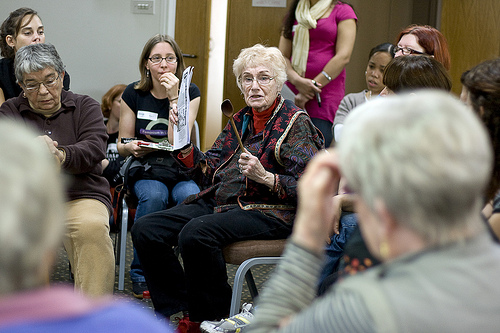
Once arriving at the conference (and swapping my chocolate pudding for a piece of cheesecake at an empty chair) I finally got an answer, and what shocked me most was the age. There were many, many passionate feminists in attendance that were old enough to be my mother or grandmother. Of course, there were the Riot Grrrl style girls, keeping the look alive with shaved heads and pierced septums. There were also women of several races represented, including a wonderful group of black ladies that sat behind me and talked back to the Patricia Hill Collins keynote speech like they were in church, saying things like, “Mmm-hmm. That’s right. You tell ’em sister.”There were even a few (gasp) men there, including my favortie feminist male, AliasMitch. However, the highlight of the weekend was when a tiny gray-haired lady picked up a copy of SisterSpeak and said, “Is this a ‘zine? I’ve always wanted to see one.”
In 1986 Baba Copper wrote an article called “Voices: On Becoming An Old Women” that explored the “ageism” that exists between young and old women. Within the feminist movement, this prejudice becomes an especially poignant problem because it creates a divide between the second and third wavers. Copper discusses the ways in which the old are oppressed by the young, but especially in the case of women, suggesting that female competition for power within a patriarchal culture regulates old women to the outskirts of society. “The foundation of lies built into passing [death] and the fear and loathing of female aging are what keep generations of women – decade by decade – divided from each other,” she explains.
By internalizing ageism, third wave feminists are missing out on a reservoir of knowledge that would only aide in the progression of both generation’s like-minded goals. It is certainly more convenient and seemingly more fun for twenty year olds to look up the the likes of Jessica Valenti and Courtney E. Martin, the women behind Feministing.com who are yo ung enough to be our sisters, but Copper believes that, “Empowerment of women will come when we identify with women older than we are and not before.” After hearing Patricia Hill Collins speak in Richmond, I understand the gravity of what Copper was saying.

I mean, we’re not so different from these two ladies.

Collins was born in 1948, making her sixty-three years old. That’s forty years longer then I have been alive – should I really be surprised that she had wisdom to share? She’s been in the movement for decades longer then I, and already gained insight to some of the problems I come up against in my daily life. For example, she gave advice about how to educate one’s family and friends on feminism, stressing that alienating scholarly language must be traded for discussions centered around concepts and ideas. She suggested that we try listening instead of teaching, engaging our close ones in analytical conversations rather than lectures, admitting that this skill set can be painful to acquire. Education may cause feminists to feel like an outsider at home, but addressing the personal concerns of those around them provides the opportunity to bring real-life issues back to school to discuss in the classroom.
The “college bubble” I mentioned before may make it difficult to network with other generations of feminists, but the reward of such actions was evident after just minutes of Collins speech. I want to consciousness-raise with some old ladies. Anyone with me?
And that, My Wild Child, is why we should “hang out” more.
Bravo!!!
What a wonderfully knowledgable writer! The picture at the end of your peice shows incredible diversity,,,,,I love it,,,,and yes,,,,I’m with you!