
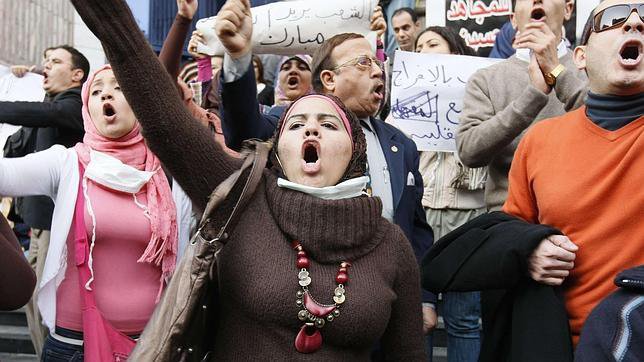
Amazing things have been occurring in Egypt in the past few weeks, and I, for one, have been captivated. This afternoon it was announced that Egyptian president, Hosni Mubarak who had been in power for the past 30 years, had fled Cairo and renounced the presidency. Watching the mass groups of protesters celebrate on Al Jazeera’s live stream was simply incredible, and, it may be clichéd, but I’ll say it anyway, an astounding testament to the power of the people as a collective. Even more amazing, and a phenomenon that has not gone unnoticed, but perhaps deserves more attention, is the presence of women in the uprising. Women have hit the street with the same force as men; they have been just as active and passionate about overthrowing their old, repressive government. Women are present in every photograph depicting the protests, the riots, and now the joy. They have been interviewed in all of the coverage I have seen (for the record, I have predominantly paid attention to Al Jazeera because they have provided the best coverage of the events). Women are everywhere. And it’s beautiful.
Seeing these women out in public spaces, decrying their government, is incredible. And it proves that they are necessary. Imagine if women were not participating in these protests (and now the celebrations). Remove what is probably half the population of these protests, and the force is not there. Frequently you hear politicians and even feminists disparage Islam as a whole because of exclusion of women. Most often these discussions manifest as debates over the hijab and burqa worn by some Muslim women. It is assumed by Westerners that veiling indicates oppression of women, and this belief has manifested in ant-veil laws across Europe. Laws which discriminate against Muslim women and do the exact opposite of what they purport to do—they keep women out of the public sphere. Women end up caught in a dichotomy between their religion and the state, and in opposition to the laws have been expelled from schools (there were many cases of this in France, for example) for wearing their hijab. The issue of religion and state is one to be brought up another day, but just to throw in my two cents, clearly these laws have nothing to do with saving women from the supposed barbarism of Islam, and instead are about codifying Islamophobia into law. But, I digress. The point is that women should have the right to choose to wear the hijab or not wear it, and forced veiling and forced unveiling are both wrong and oppressive to women.
What Westerners don’t care to think about is how Western politics and religions are also discriminatory towards women, both in attitude and policy. Women make up a paltry 17% of the U.S. Congress. As we all know, it’s not because women are less capable than men, but because women lack the same opportunities and avenues to success that men have. (Also, after the fucking fiasco that was the 2010 mid-term elections, there are currently no African-Americans serving in the Senate. None. Just wanted to point that little disgusting bit of information out). As far as women’s legislative representation in the world, the number of women in legislatures is below 50% except in Rwanda. So, clearly the West is not exactly a bastion of equal representation for women. But what this revolution gives Egypt is a beautifully unique chance to work with female activists and politicians so that they can be included in the new government. As of right now, women make up 12.7% of the Egyptian legislature, but overthrowing Mubarak and revitalizing the government, creating a democracy, can give so many more opportunities for the women of Egypt, which will then, of course, create new opportunities for all the people of Egypt to be engaged in their government. The Muslim Brotherhood, a political party in Egypt, which has supported the overthrow of Mubarak, has worked to engage women and augment their participation within the party.
Democracy is not a perfect form of government, despite what some would argue. It is still influenced by patriarchy and factors that prevent women and minorities from being adequately represented in government. However, a democracy is far more conducive to augmenting women’s representation than an autocracy or dictatorship. And this is a major reason why this revolution in Egypt has such important ramifications for the Middle East and the world as a whole. Egypt can be an example to governments in flux, it can include female activists and politicians into the fold and allow them to have a major role in the new government.
For some more info about women’s part in the Egyptian revolution, and women and Islam in general, check out activist Mona Eltahawy’s website.
Beautiful photostream featuring Egyptian women protesting is here.
Edited at 12:15 p.m.: Reports of protests in Algiers with this very interesting quote from the Al Jazeera liveblog:
“2:40pm Twitter is buzzing with reports of the role of women in today’s protests in Algiers, with some saying that police are tageting and arresting women. There are several photos of female protesters being hauled off by police on the wires.”
 ShoutOut! James Madison University
Posts like THIS is what Shout Out! is all about. Thank you for the great post, Katie O. =)
LikeLike
Phenomenal post Katie, there is something really beautiful about the power of people. Historically, tales of women as part of the revolutions are left out, and I hope a version of the one you’ve told reaches the books. 🙂
LikeLike