
In the home stretch of blog posts for Spring 2026, let’s bring the news back home to the Quad.
(Well, maybe not the Quad anymore: any non-University sponsored events on the Quad are strictly limited under JMU’s updated “Public Expression On Campus” Policy 1121.)
As a JMU senior, I’ve seen 3 big campus-wide protests during my time, addressing issues local and national. Each protest felt like a case study of what JMU does best— and what we, as students and administration, still have to learn about being active citizens.
April 2023: Liz Wheeler and The Ideology of Transgenderism
On April 6th, 2023, Young Americans For Freedom at JMU announced on Instagram that conservative podcast host Liz Wheeler would be speaking at JMU. By April 17th, a second Instagram post announced the name of the event:
Campus was abuzz. A GroupMe chat (since deleted) of disbelieving students made the rounds, racking up around 400 student members within the first day. A few organizing students in the group were planning some kind of protest, while the rest of us talked at length about every corner of the controversy— was this free speech? Hate speech? What could we do?
I remember the excitement, the righteous anger. The protest event, we decided, would be called “Dukes For Pride”. There would be drag queens performing. We’d light up Wilson and Forbes in the trans flag colors. If JMU admin didn’t show up to a capital P Protest— well, of course they wouldn’t. But not accepting a direct invitation to celebrate JMU’s queer students (conveniently taking place at the same time as the Transgenderism event)? That doesn’t read well.

The evening culminated almost exactly as planned. Seeing hundreds of queer JMU students gathered together, standing up for each other was an emotional experience. We walked in a beaded and bannered crowd from the Quad to the Festival Lawn. Tim Miller even showed up at some point. At the end, I watched protestors disperse under the prettiest East Campus sunset I’ve seen to date.

May 2024: Palestine
JMU was a little slow to join on the nationwide college protests against the genocide in Gaza. We got our start in May— banners and quilts and cardboard signs propped up near The Kissing Rock on the quad, right outside Alumnae Hall. Dozens of schools had come before us, and now it was our time to be swept up in the current events.
The crowd was mixed— always about 60 students gathered, no matter the time of day. Well-educated students and faculty gave lectures to wide-eyed students who would do whatever to be on the right side of history. We had demands: financial transparency from JMU, divestment from Israeli companies and weapons manufacturers, the release of a statement condemning the genocide. There were small student committees— I joined security, tasked with printing out jail support forms in the case of an arrest. This protest had gravity. This felt real. National. Adult.
The Palestine protests lasted three days. Eventually, the caustic discourse around campus spilled into the encampment, and a group of fraternity students came brandishing odds-and-ends weapons (pool noodles included?), to retaliate. Words were exchanged, campus police were summoned, the protest dispersed. I remember the surreal feeling— getting the pseudo-fight we’d been anticipating, after a hot three days of wondering how we’d manage to sustain protests through finals week, let alone the summer.
Summer 2024: A Free Speech Interlude
That summer after the Palestine protests, JMU administration quickly tightened its Public Expression policies:


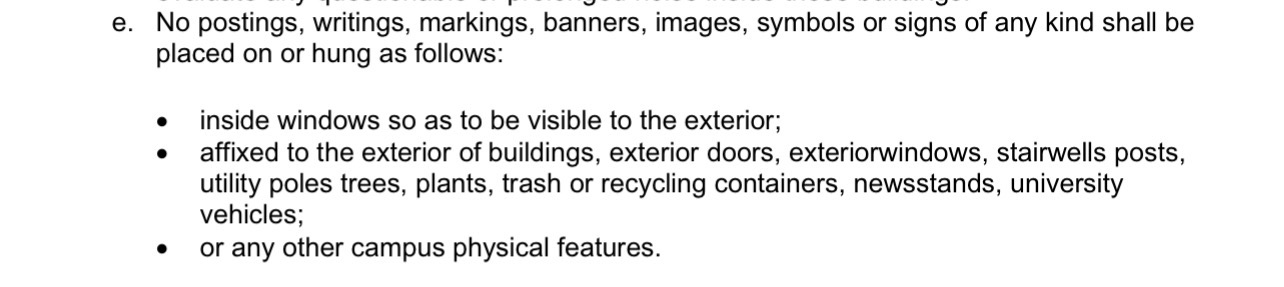
February 2026: ICE Out Protests
A national issue made local, the threat of ICE officers arriving en masse in Harrisonburg saw JMU students showing out once more. The only notice came via guerilla flyers placed on tables all across campus. To be honest, I had low hopes for this one— between the bad weather and JMU’s status as a PWI (primarily white institution), I figured our capacity to mobilize on this issue wouldn’t be the greatest.
As it turns out, plenty of students showed out, to march from Burruss (originally the Quad, relocated after a kind suggestion from admin) to City Hall. For all my doubts, I was so impressed by the turnout that I joined the GroupMe. Already, post-protest efforts were in full swing, planning follow-up protests and events: A collaborative event with Latin Dance Club? someone suggested, and a LATIN DANCE PARTY channel was made, alongside FUNDRAISERS, ZINE CREATION and SAFETY ESCORT.
Maybe this is the formula? A quickly-organized in-person event to raise the spirits (and awareness), followed by a democratic, virtual sustaining of efforts? Access to “controlled spaces” or not, this may be the order of operations that really works to mobilize JMU students towards sustainable actions in their community.
One thing I’ve never doubted is JMU’s capacity to turn out. Sure, we’re in a bit of a post-COVID mid-CHATGPT slump of activity, but nothing fuels the JMU student body like a common enemy. Think Brother Ray. “Walk.”gate. The (temporary) removal of the Starbucks truck. The refs at every football game.
What I do doubt sometimes is what we’re willing to stand FOR. I’ve seen state elections drift by, eclipsed by 7-Brew promotions, midterm cramming, and arguments about “touse” or “bouse” on YikYak. I’m not saying every JMU student needs to abandon their creature comforts to form a 22,000-person commune of 20 year-old pseudo-Buddhist revolutionaries. It’s a state school. The day won’t come.
But time and time again, I have seen the better nature of JMU students as active citizens. I’ve seen us pick our battles well, and refine structures of protest to be more inclusive, productive, and sustainable. I’ve seen us remember that there are stakes higher than our GPAs, and microcosms of societal fissures on display right here at JMU. I’ve also seen how the university responds to these attempts at free speech, for better and for worse (right now, it’s for worse.)
I KNOW JMU students can protest. Our scrappy nature is one of our greatest strengths, when wielded well. I hope, in an era of Strategic Planning and vying for national recognition, that JMU administration, policymakers and students don’t forget this.