
We encourage women to break glass ceilings, while others sit detained in cages.
We love the idea of empowering women- the CEO, the politician, the “girl boss”. But what about the migrant mother detained in an immigration center?
Why does feminism suddenly get quiet at the border?
Immigration detention is a pressing human rights violation and is at an all-time high. Women, trans people, LGBTQ+ individuals, and all gender-diverse people face disproportionate risks when held in detention centers. If feminism is truly about empowerment, bodily autonomy, justice, and safety for women, then immigration detention cannot continue to exist outside of feminist conversations.
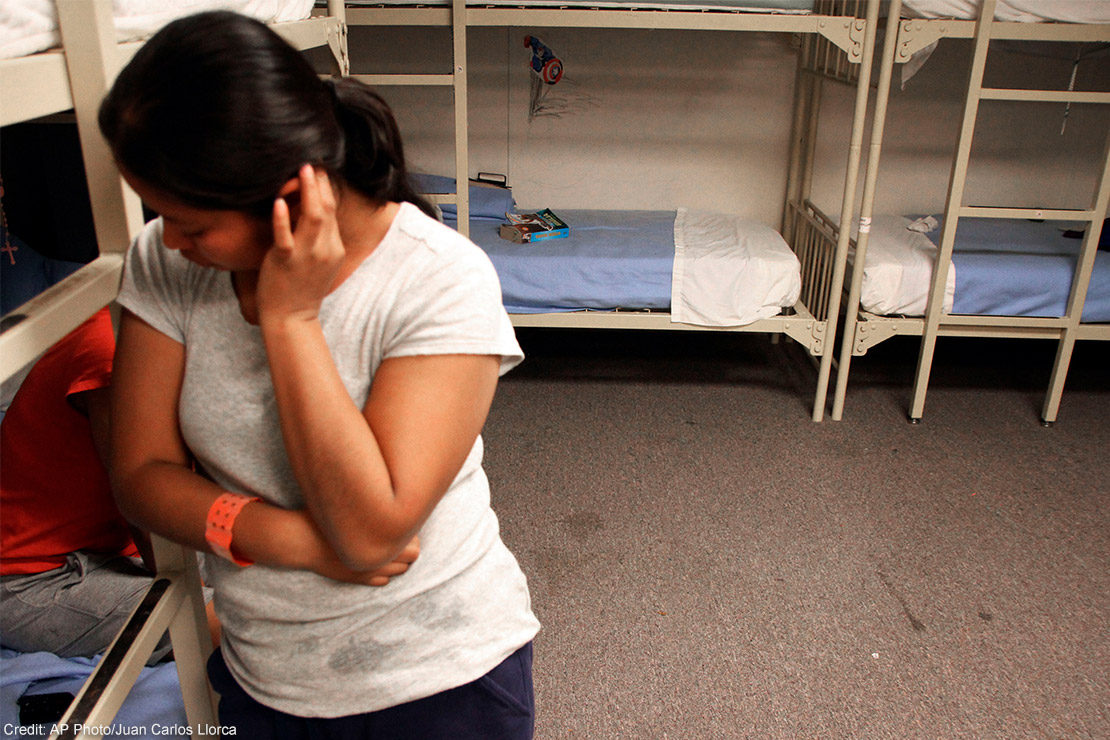
Photo by Juan Carlos Llorca, Immigration Detention Center, via: https://www.aclu.org/news/immigrants-rights/immigration-detention-and-coerced-sterilization-history-tragically-repeats-itself
Sexual Abuse and Violence
Detention centers are hotspots for gender-based violence. With limited sex-segregated facilities, women and gender-diverse people are placed at higher risk. Protocols such as locking detainees in cells overnight and cutting off all electricity often make safety impossible.
Male guards and detainees are often perpetrators of sexual abuse in immigration detention centers. Abuse ranges from rape, harassment, assault, coercion, groping, to even watching women as they change or shower. Detention centers don’t prevent abuse, if anything they perpetuate it. And in a place where needs are often ignored, the power imbalance between detainees and staff create little to no consequences.
And trans, nonconforming, and gender-diverse people face the same risks. Alongside physical and sexual violence, they are often detained according to their sex assigned at birth. This creates new risks of trans and homophobic-based violence, as well as a target placed on their back from the very beginning.
Lack of Healthcare
Within centers, there’s limited to no access to medical practitioners trained in women’s health. They typically have no access to gynecologists, screenings for breast or cervical cancer, contraception, menstrual products, STI testing or treatment, or abortion services. This is a direct violation of women’s right to bodily integrity and reproductive justice.
Pregnancy
Pregnant women face some of the highest risks in immigration detention. Not only is there little to no access to women’s healthcare, there’s inadequate food, prenatal, and postnatal care. So many women have reported extreme neglect of not just themselves, but their babies.
One woman reports being detained for more than 20-weeks during her high-risk pregnancy. She wasn’t able to receive medical attention until other women in the denetion center advocated for her. Food was limited and often unedible, and when she asked about missing prenantal vitamins, an officer met her with, “You won’t die if you don’t take them”.
Another woman experienced heavy vaginal bleeding but was denied medical care for several hours. Medical staff took her to an isolated room and left her alone, bleeding out, for hours. No food, water, or medication. With her arms and legs shackled, she went to the emergency room and required a blood transfusion after experiencing a miscarriage.
These stories are neither unique nor the worst cases. They’re the stories of so many women experiencing pregnancy in detention. Read more about women’s stories here.
Feminism Cannot Ignore Detention
At its core, immigration detention is separation- from families, community, and from fundamental human rights. Yet these realities rarely appear in mainstream feminist conversations, despite the dire and detrimental effects on women detained today. We can continue celebrating the empowerment of the woman CEO- but we cannot continue to evade conversations about detained women who desperately need visibility and support. If feminism truly seeks justice and autonomy for all women, it cannot stop at the ceiling. It must also confront the systems that confine and strip migrant women of their rights behind detention center walls.
A movement that celebrates breaking glass ceilings must also acknowledge the cages that still confine so many women today.
References:
 ShoutOut! James Madison University