
Winter guard is called a “sport of the arts” because of the mix of artistry and physical demands, but it also rings true when it comes to gender stereotypes found in both performing arts and sports. Even though the guard may spend hours on hair, makeup, and are clad in sequin studded, vibrant uniforms, the athleticism required of performers can’t be understated.
Winter guard is the indoor version of outdoor color guard, where we spin flags, mock rifles, sabres, and dance to bring life to music, but it has many more differences than just being inside. While you can find the outdoor JMU color guard accompanying the Marching Royal Dukes at halftime and pre and post game performances, the JMU Nuance winter guard competes weekly in local and national circuits with a show that has higher, harder tosses than what we could achieve outdoors, and our shows often have a level of theatricality and depth than what someone would find with an outdoor show.
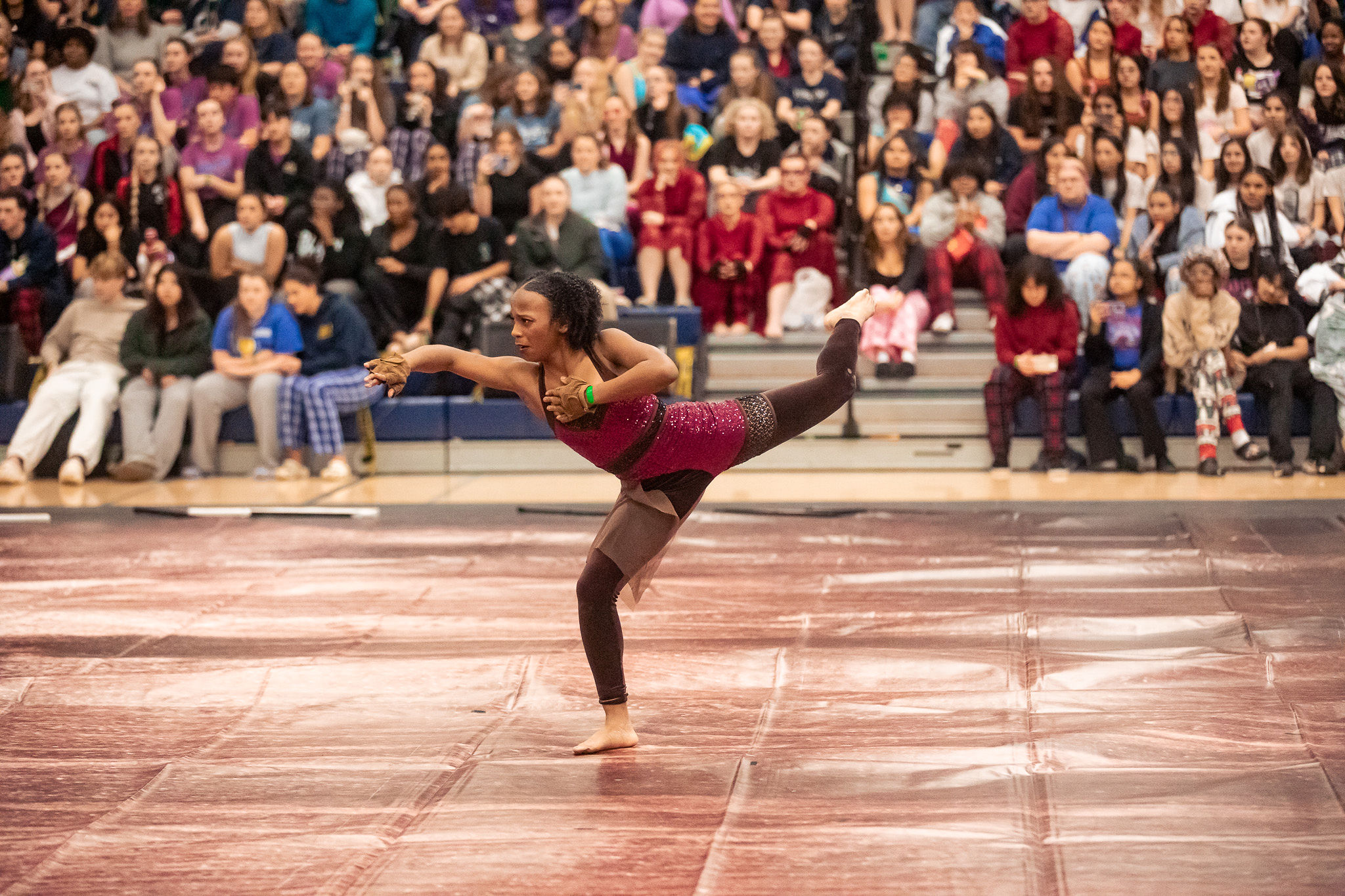
All JMU Nuance winter guard members spend up to thirty hours a week in a gym perfecting our craft through conditioning, technique training, and spinning parts of our program past the point of exhaustion. It requires discipline, focus, strength, and commitment of all athletes, who all complete the same training and conditioning, no matter our role in the show. While all genders and identities are welcomed and represented in the guard community, women tend to make up the majority of guard performers, and this holds true for Nuance as well. Nuance is made up of 48 spinners, only 7 of them identifying as male. When we are judged, our strength and stamina are commented on by judges, but when compared to other female dominated performance sports, like dance or gymnastics, perfection is not demanded. In my experience at JMU, there is an emphasis on making sure that all members, especially women, feel comfortable and confident in their movements and uniforms.
Despite this, I have overheard many of my female teammates commenting during conditioning that they hope that the exercise makes them skinnier, including phrases popular on social media such as “Good luck finding my waist”. As high-performance athletes, why do we still feel the need to make ourselves smaller? Daintier? Even in a culture that has largely been formed by women, patriarchal ideas have still found a way to continue to control how we as women view ourselves as athletes second and objects of desirability first.
Falling into the habit of idealizing being small is scarily easy. I have found myself going along with my teammates, making comments about myself and my size during conditioning, despite guard being incredibly healing while I was facing a battle with an eating disorder and body dysmorphia stemming from a decade as a competitive gymnast. I know firsthand the harm that these statements can do when someone says them and means it, but there is something sickeningly validating about hearing other women strive to be small that makes it seem less like a harmful desire and more like encouragement. Because I was aware of the damage the ideas behind celebrating getting skinnier can do, I thought that saying things that glorified being small gave me power over the words, when in reality, the idea that “the smaller I am, the more worthy of my spot I am” is not only preventing myself and my teammates from reaching our full potential, but also upholding the gendered stereotypes that caused this mindset to exist in the first place.
For more information on winter guard, visit:
 ShoutOut! James Madison University