
A couple weeks ago my childhood was fulfilled for the first time since Toy Story 3 when The Lego Movie opened! A Lego-lover from an early age, the child in me leapt at the idea of seeing my favorite toys act out cinematically, and I only got more anxious reading how well-received it became. The feminist in me rejoiced over the diverse cast of characters that pass the Bechdel Test (consisting of a cast that has to have at least two named women in it, who talk to each other, about something besides a man).
 While slowing down commercial movie sales, it remains the highest rated movie currently in the box office (82% on Metacritic). What better way to capitalize on this success than a movie tie-in with matching Lego sets? But if you’ve been down the Lego isle recently, you’ve likely noticed the division between the dark blue boxes from the movie and several rows of bright petunia pink boxes. You guessed it; it’s time to talk about gendered toys.
Making their debut three years ago, the pastel colored Lego Friends line of toys was the company’s response to reaching female consumers. The toys were the end-result of a multimillion-dollar study and product testing effort. The final Lego sets are remarkably different than previous Legos, focusing on girls from the bottom up.
The most noticeable change is the inclusion of more realistic minifigures (the humanoid Lego people) with fully mature bodies and model skinny waistlines. Additionally, the color scheme is completely pastel or unsaturated in pigment, creating a softer effect to the eye. Of course, the sets incorporate typical gendered situations or scenarios, like going to a mall or cruising in a bright car with friends. An accurate representation of today’s leisurely lifestyle and bourgeoning culture right? Literally, think Malibu Barbie meets Poly Pocket meets Legos. It’s amazing how these sets seemed to deviate from the Legos of the Lego Movie.
The Lego Movie play sets are a great example of how to do Legos right. The sets are diverse, and compatible with any other Legos. Furthermore, they’re gender neutral, often including the two main characters, a goofy male and smart female lead. This comes in stark contrast to the pink washed toys sitting less than two feet away from them on the same shelves.
This story hits a personal cord with me because Legos mean so much to me. I’m willing to go on the record and quantify that possibly 30 to 50% of my childhood consisted of Legos products of all different sizes, shapes and variations. From daycare when my parents prayerfully whispered, “architect,” between themselves, to just recently using Legos to bond with kids with learning disabilities, I have truly grown up with these multicolored blocks.

One of the brilliant things about Legos is their ability to be reimagined and recreated at will. As a kid with a wild imagination, these things allowed me to go to the moon and beyond with combinations and plotlines only limited to my creativity. One set had endless possibilities; many a holiday I was contained with a single simple set! So when I look at the Legos of today, I’m concerned with supposed messages Lego is sending.
Further down the line when I’m a father, I don’t want to have my daughters and sons assume they’re limited to arbitrary things like color (pink for girls), social roles and obligations (only boys are police officers and save the day), or personal values (girls shop and stay at home, boys go on adventures). I want them to grow up limitless like I was, unbound by societal norms, and untethered to conventional thinking. I want them to grow up in a world of boundless possibilities so that they can believe they have an opportunity to pursue exactly what they want to!
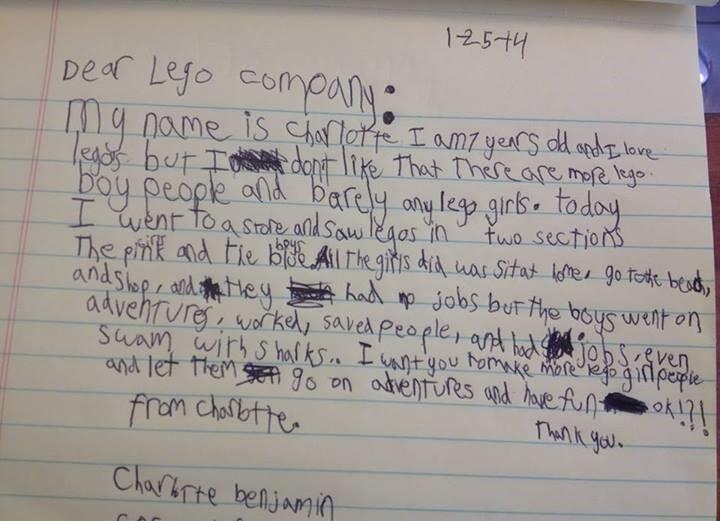
Think my feminist observations are overly critical? Read the observations from 7 year-old Charlotte, and leave a comment bellow on your thoughts about gendered toys.
 ShoutOut! James Madison University
Oh my gosh that note is fantastic! We have future leader in the works! This is an awesome piece thank you for writing about this! Have you heard of Goldie Blox?? I saw this commercial and thought it was hilarious – https://www.youtube.com/watch?v=rpmMzeWj6LU
LikeLike