
Please note that this post contains profanity and strong sexual content.
In light of the recent outrage regarding the meaning behind Robin Thicke’s “Blurred Lines” single, I’ve decided to weigh in on the hoopla. I’ll be upfront in saying that I’m challenging what I consider to be a strong instance of group-think that has gotten wildly out of hand. As the feminist community started alleging that the song had strong implications of sexual assault, I immediately stopped listening to the song. I felt totally disgusted every time it came on the radio. And I had even less respect for Miley Cyrus for willingly performing a song that would make rape seem even remotely mainstream or glamorized. 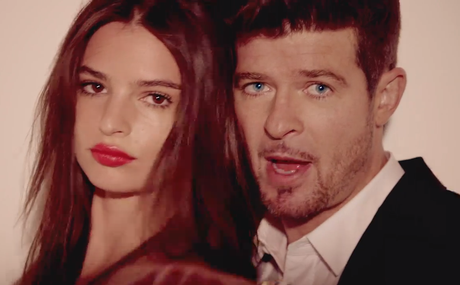
The problem is that I never looked up these lyrics for myself, and instead bought into this protest of Robin Thicke without having actually critically assessed the (stupid) song first. Truth be told, I didn’t really give a shit about this song much at all—yeah, I liked the beat, and the tune was catchy. But other than the occasional listen on the radio, or the tacky rendition at the VMAs, “Blurred Lines” wasn’t on my radar.
It wasn’t until I watched the feminist parody, “Defined Lines,” that I took interest. In fact, I hadn’t seen the “Blurred Lines” music video yet, so the parody was doubly shocking. Images of men stripped down to their skivvies wearing bondage and at the mercy of “empowered” women singing about “emasculating” and “castrating” men didn’t sit well with me. Nor did the image of one of the women in the video shoving a vibrator in the dude’s mouth.

However, I was told that this approach was “totally justified” given the original, unrated version of the “Blurred Lines” video. That video shocked me as well—bare-breasted women awkwardly standing around in nude panties and making weirdly sexual faces when given a close up from the creepy camera dude. Throw in some random goats, a “Robin Thicke has a big dick” poster, and you have one strange, pointless music video. However, when placed in the context of the song being about rape, I didn’t want to raise any questions. I just wanted to think.

I’ve come up with two points. First, the argument that the song “Blurred Lines” is about rape doesn’t hold weight. Secondly, the response from a portion of the feminist community is frankly beneath us: if equality is what we seek, we can’t do it at the expense of indiscriminately vilifying the entire male population. Honestly, that tactic is nothing more than a great way to devalue our message of equality.
I understand that my first point is going to raise eyebrows, but I’m asking you to first check out these lyrics for yourself. “Blurred Lines” is a weirdly sexual song at best—but there is nothing in the lyrics that implies non-consensual intercourse. Here are a couple excerpts:
OK now he was close, tried to domesticate you
But you’re an animal, baby, it’s in your nature
Just let me liberate you
You don’t need no papers
That man is not your maker
From this, we can infer that Robin Thicke thinks a taken woman is hot, and would really like to engage in intercourse with her. He doesn’t think that the said woman’s significant other is treating her right—“that man is not your maker.”
You may be thinking, “Well, the fact that he’s giving her unwanted attention is grounds for assault, even if it’s not rape per se. Unwanted sexual advances is a form of assault.” Excellent point, especially when we consider the highly controversial line “I know you want it.” Does she really want it? Or is he saying that to justify his assault of the woman in question? Let’s place those lyrics in context:
I hate these blurred lines
I know you want it (3x)
But you’re a good girl
The way you grab me
Must wanna get nasty
Go ahead, get at me
Okay, so he hates the blurred lines of attraction. She’s taken, and “off limits”, but she’s giving him reason to think she might be into him—“the way you grab me/must wanna get nasty.” To this, he replies, “get at me.” Said another way, “I’m putting the ball in your court.” Perhaps if he had said “I’m coming after you” or “I’m gonna get you,” then maybe my point would be weaker. As it stands though, we have a-guy-who-wants-a-girl-but-can’t-have-her-but-wants-her-and-she-wants-him-and-he’s-hoping-she’ll-make-a-move. That’s not rape, that’s human sexuality.
I’m not even sure why this would be the song that grabs at our attention, when it sounds like every other stupid song that talks about wanting to get with a “bad bitch” and “tear that ass up.” Yes, that’s a crass way to talk about women (though some like that kind of dirty talk, I guess). No, it’s not implying rape. If we want to talk about how mainstream song lyrics project a disrespectful image of women, then I’m totally on board. But calling that “rape” is absolutely invalid—that argument is totally different.
I’ll continue my discussion of this topic later this week in Blurred Lines of Interpretation, Part 2, where I’ll discuss the implications of the “Defined Lines” parody. In the meantime, I want to open this up for discussion: what do you think of the controversy?
For further reading:
 ShoutOut! James Madison University
I loved this post! I was on the same train of thought as you earlier this summer when word started getting around about the song’s controversial meaning. You proved a really interesting point that I hadn’t initially thought of. I hadn’t looked at the song’s lyrics before so it was really helpful that you pointed out specific examples. Looking forward to your next post!
LikeLike
While I appreciate that you’re looking at this from an alternate perspective, I highly recommend reading this piece which juxtaposes the actual words of rapists with the lyrics of “Blurred Lines.” Also, Thicke has openly admitted in multiple interviews that the point of this song & video was to degrade women, which he referred to as “a pleasure.”
http://thesocietypages.org/socimages/2013/09/17/from-the-mouths-of-rapists-the-lyrics-of-robin-thickes-blurred-lines-and-real-life-rape/
LikeLike
Excellent post! No blurriness here–and I agree with you. (Plus I think the song is catchy as hell, implied misogyny be damned!) great writing–active & to the point!:)
LikeLike
Yeah…I definitely agree with what you said about “Defined Lines”. That first time I watched it during our class meeting, I was kind of shocked so I laughed, but I was SO conscious of ElFeministo in the room. I wondered what he was thinking about that display? As feminists, we are supposed to be proponents of EQUALITY. Defined Lines, while somewhat shocking and funny because it is so different from mainstream society values, obviously isn’t an equal picture. No one should be degraded for any reason – gender or otherwise. Your caption under the picture says “We don’t increase our value be devaluing others,” and I totally agree with you!
LikeLike
I must say that you have completely enlightened me of the controversy of this song. Like many others who absolutely love upbeat music that you can dance to, I am guilty of listening to this song. The issue that I have with songs like this is that the beats are so catchy that I literally never pay attention to the lyrics (I will sing them and everything but not really think about what they are saying). I enjoy listening to this song to this day, I originally heard about it from all of my friends who acted like it was the best piece of music in the world. I have always associated this song with a “line dance” because when I was introduced to it, I was taught the dance. Now to answer the question… I feel some type of way that this song got all of the attention when there are all types of songs out there that use derogatory terms by referring to women as “bitch”, “hoe”, “tramp”, etc. Yes, I understand that the song itself does not represent women well and I agree that if I were to actually look up the lyrics that I would be disgusted. However, calling this “rape” is not justifiable. I appreciate the way that you broke down the lyrics because it made a lot of sense to me and I think that if people would have taken the time to analyze it then there may have been a lot more views like yours.
Don’t get me wrong, I am not implying that this song is great and it should never have been recognized as a song that degrades women. I am saying that there are many other songs that may actually suggest that “rape is OK”. I do not think it was a good idea to stoop down to the level of created a “Defined Lines” video. As you said, we as women should be fighting for equality and not making it acceptable to generalize men in such a negative way.
LikeLike