
Dr. Jen Almjeld has been at JMU for 12 years, focusing on Girlhood and other feminist topics. Along with her Feminist Rhetorics class, she is the internship coordinator and works with JMU grad students. She loves collaborating with people and learning about their personal goals along with their academic ones. From being in a few classes with her, I can attest to this statement: Jen really goes the extra mile to create a welcoming environment for everyone she meets.
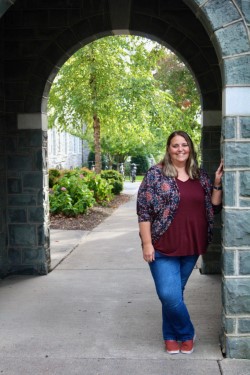
Dr. Almjeld grew up in Bria, Kentucky, where she was raised in a Christian household. Jen briefly mentioned that her religious experiences led her to become interested in Girlhood and feminist rhetoric as she would frequently question gender roles in her traditional religion. These questions and disconnect led her to pull away from the church for a bit, allowing her to find the Evangelical Lutheran (ELCA), which she now practices. I didn’t ask many questions regarding religion, but Jen talked about how she considers herself a spiritual person who practices religion through creating connections and being in nature. This part of our conversation was really beautiful to hear, as I think many of us struggle with the idea of organized religion.
After discussing some background, I inquired about the WGSS field. I was curious to know more about her interest in teaching Girlhood and how she handles the current political climate when discussing more “liberal” ideas. She told me that Girlhood is an overlooked area, and by “Making space for voices and practices that are ignored and aren’t taken seriously” we can empathize and understand marginalized communities better. I asked her what teaching in Harrisonburg was like, because I think we forget that our small town is in a bubble surrounded by a more conservative state. She started by expressing her gratitude for living in a state that isn’t completely censored, and she can still use words like “diversity” and “intersectionality”. This is a privilege that some of her co-workers living in Florida and Texas can’t share, and Jen knows their future in WGSS might change. We talked about how WGSS might be at risk, even at JMU, when the new president is hired.
I was frustrated to think about how we live in a world where the word “diversity” could be flagged. Despite this, I know how important it is — especially as an educator — to try and create a welcoming space for everyone, even those who disagree with you. I asked her how she handles tougher conversations and how she might recognize personal bias in her own classroom. She explained her goal was to create spaces that welcome people from different backgrounds, and acknowledged that change can only come from difficult conversations. This idea has been a common topic in our class as Mikki Kendall frequently mentions the need for uncomfortable conversations and accountability in order to progress.
Her mindset of valuing a person over their opinion helps her understand discussions from different lenses, and by sharing her own personal privileges that acknowledge her biases, it helps others understand her. Jen openly expressed that she is messing up all the time, and “we all have biases, and we all have things embedded in us”, but continuously working to understand different perspectives is what will help both her and her students.
As I mentioned earlier, Dr. Almjeld actively works to create an inclusive environment for everyone, and not only is she an amazing educator, but an incredibly kind and empowering person. I recommended her classes to everyone I meet, as they have truly added so much value to my time here at JMU.
https://www.jmu.edu/academics/undergraduate/minors/women-and-gender-studies.shtml
 ShoutOut! James Madison University