
Aunt Flo is in town. It’s that time of the month. They’ve got business to handle. They’re dealing with their monthly visitor. Whatever you call it, most grow up learning the one thing to avoid saying. I am on my period.
A First period experience
When I was little it was always about being discreet. Be respectful. I was a late bloomer; I got my period in a Dunkin’ Donuts bathroom when I was fourteen on a family trip. It was mostly men, my dad and my brothers, and there was my mom. We were in the middle of Boston, ironic, I know, out of all the places in Boston, Dunkin’ Donuts, but there I was, and I did not know how to tell my mom. As I climbed back into the car my older brothers took up the back seat, my other two on either side of me, my dad was driving and I was sat uncomfortably in the middle seat, squirming. I remember wanting to scream at the top of my lungs, but I remained collected, leaning forward very gently, and whispering to my mother that I had gotten my first period. She quickly asked my father to pull into the nearest gas station, and at that 7-Eleven we parked the car, and it was there I met my very first pad.
I remember being confused that I could not just announce to my entire family what was happening but as the months grew and Aunt Flo kept her monthly visits, I began to get aggravated. I shared a bathroom with my brothers but kept my menstrual products in a pouch to conceal them. If I even said the word period my brothers recoiled, as if it was something so monstrous to hear, my dad would awkwardly pat my back and tell me to talk to my mom and I laughed, because I knew he was trying to be supportive though he had not the faintest clue what was going on.
Let’s Talk ABout It
What I’m getting at is, why are we, people who bleed, unable to talk about having our period. In 2015, Rupi Kaur, a Canadian poet and illustrator, posted a photo of herself in bed with a visible period stain on her pants as well as the sheets. Instagram took down the photo twice, as it violated the app’s norms. Kaur continued online about this sharing that Instagram has continued to “promote a long tradition of people who menstruating…as though their bodies are naturally dirty.”
People who menstruate are at risk for developing shame if they are constantly told that having a period is a negative thing. Menstrual shame can be experienced among young children who are taught to maintain a silence and secrecy regarding periods. The simple experience of embarrassment when hiding a tampon on the walk out of the classroom can lead to a lifetime of influence in a negative manner.
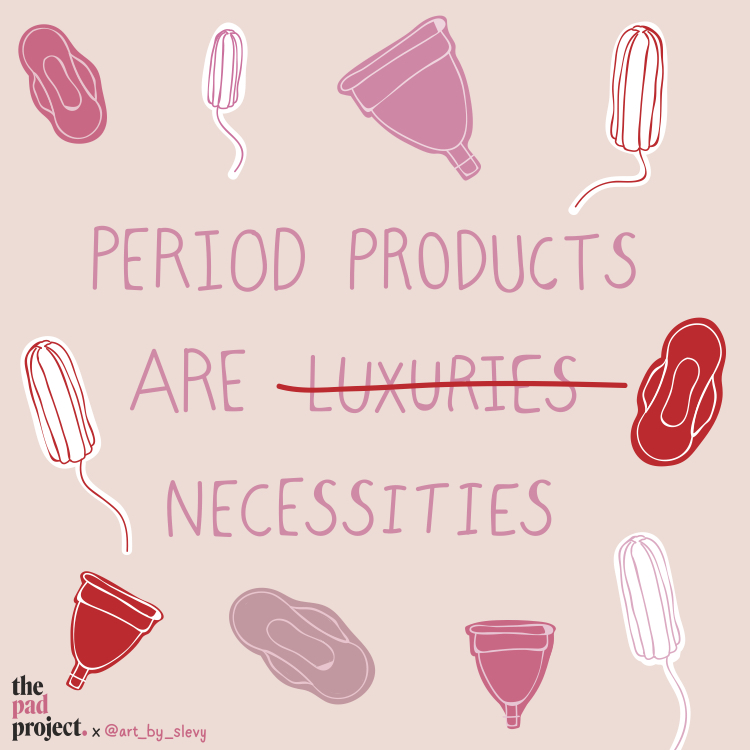
In addition to the cultural stigma surrounding people who menstruate, period products accumulate a Pink Tax, ranging from 4% to 7% in some states as period products are considered luxury items. The Pink Tax can also be applied to other products in which products marketed towards females such as deodorant or even razors cost more than the equivalent products that are marketed towards males. I could go on, but that can be another whole blog post.
What I’m saying is the media, cultural stigma, and even the markets which we shop at can tell us that having a period is a negative experience, but it’s not. Not even close. Breaking the secrecy and silence regarding periods can be a form of resilience and it might even be able to influence the next person to embrace it.
 ShoutOut! James Madison University