
“We often think of gender violence as women’s issues that some good men help out with.”
This is one of the opening lines of a TED talk given by Jackson Katz, an awesome feminist educator and activist, regarding our society’s thought process on the issue of gender violence. October is Domestic Violence Awareness Month, and what better way to continue the conversation then with a thought-provoking TED talk? Katz’s TED talk, “Violence Against Women: It’s a Men’s Issue,” offers a unique perspective on intimate partner violence and other sexual violence issues that is relevant both this month and this day in age.
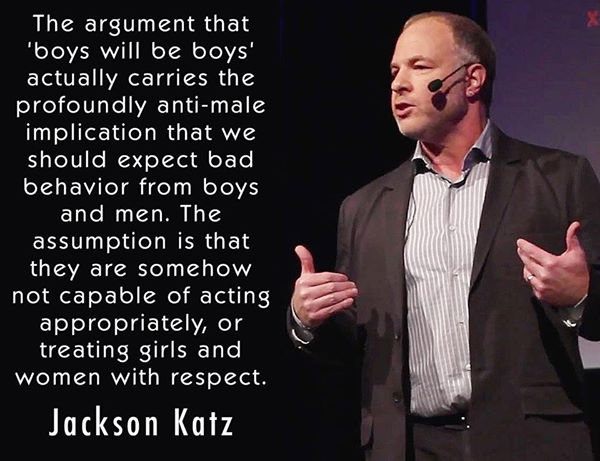
From facebook.com
In his TED talk, Jackson Katz challenges the idea that gender violence is simply a “women’s issue.” Katz says that this frame of thought is yet another sign of male privilege—the ability to ignore these issues and go unnoticed in the typical discourse regarding gender violence. Instead, he proposes a shift in perspective, wanting instead to think of the issue of gender violence as “men’s issues.” Katz demands that men begin holding themselves and other men responsible for the violence committed against women and to take active steps to stop these acts from continuing.
One of my favorite aspects of Katz’s talk focuses on the victim-blaming thought process that occurs in discussions of intimate partner violence. Katz explains how the conversation and tone changes using the example “John beat Mary.” He then switches to the passive voice and writes “Mary was beaten by John.” This is an important moment because the focus now switches to Mary, instead of John, who is doing the beating. He then takes away John, leaving simply “Mary was beaten.” After a few more transitions (replacing the term “beaten” with “battered”), he leaves the sentence “Mary is a battered woman.” This is currently the way we think about intimate partner violence: thinking about the survivor as having acts of violence done to her rather than thinking about the perpetrator of that violence.
Now, I will admit that I wish Jackson Katz’s talk had been a bit more inclusive and included violence against men as well. However, I believe that Katz’s goals were to highlight the main victims and the main perpetrators of gender violence (women and men respectively), to point out our flawed ways of thinking, and to offer a new perspective on an issue that is steeped in victim-blaming and stereotypes. I think he was pretty successful at all three.
This TED talk is extremely appropriate this month, both on a national level and right here at JMU. Next week (October 20-24) is Awareness week for JMU’s Red Flag Campaign, a campaign dedicated to increasing awareness of the dating violence that occurs on this campus and to promoting prevention of it in the future. The Red Flag Campaign encourages people to look for “red flags” in relationships, so that if they see something suspicious, they will have the knowledge and the courage to speak up about it. Below is a list of events throughout the week—I highly encourage everyone to check them out and get educated on how to prevent gender violence in our own community. Above all, gender violence is a HUMAN issue, and that means both genders need to actively help eradicate the problem.
RED FLAG CAMPAIGN AWARENESS WEEK EVENTS
October 20– Giveaways and education on the Commons from 12-3pm; “Understand Destructive Relationships” Workshop, HHS 1209 at 6pm
October 21-Red Flag Themed Open Mic Night, TDU, 7pm
October 22-Wear Red Day to support the campaign and raise awareness; Red Flag themed MAD4U Tea Time, Warren Patio, 4pm; Queer identified feminist activist speaker Melissa Fabello, Festival Ballroom, 7pm
October 23– Red Bake Sale on the Commons from 12-3pm to raise money for a local intimate partner violence nonprofit
October 24– Giveaways and education on the Commons from 12-3pm
Here’s more info on the national Red Flag Campaign if you’re interested!
 ShoutOut! James Madison University
Thank you so much for sharing! I especially loved the paragraph about the way we form sentences to describe victims of abuse… it’s amazing how switching around the words and verb senses really makes a difference. Also, thanks for sharing the events happening on JMU’s campus this week- I really want to go to the speaker of Wednesday!
LikeLike
Thanks! I thought the talk brought up some great points on the cognitive constructs we use when discussing intimate partner violence, and hopefully that can get us thinking about the issue with a new perspective!
LikeLike