
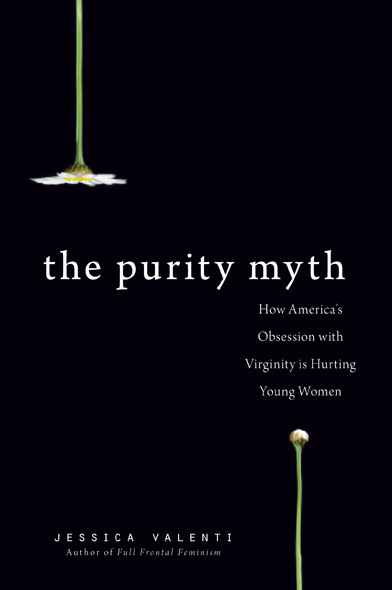
For the longest time, my roommate has been trying to get me to read Jessica Valenti’s The Purity Myth. The book talks about the myth of virginity and the implications it has for culture. After now reading it, I can’t believe it had taken me so long to sit down and do so. Valenti’s witty and sharp voice so clearly lays out the struggles facing young women and why things like abstinence only education are harmful to society.
For this post, I wanted to lay out some many ideas discussed by Valenti that have really stuck with me. They’ve made me angry and definitely made me think. In the end, I would highly encourage everyone to read this book.
1. By putting an emphasis on young women staying “pure” and “innocent” by abstaining from sex, it makes their value based on something they’ll do or abstain from. It unfairly brings into account morality. Valenti points out how problematic this is that we’re defined by the ethics of passivity. As women, we’re valued by not doing something.
2. Author Hanne Blank discovered, after spending some time in Harvard’s medical school library, that there is no definition regarding virginity. Blank ran the website Scarleteen, answering young girls’ questions about sex. They all wanted to know, if they did “x, y, or z,” were they still a virgin. Blank found that no scientific definition stands. Nothing exists in any medical dictionaries, encyclopedias, anatomies, etc.

3. Continuing on the topic of virginity, Valenti’s favorite definition was told to her by a close friend, Kate. Kate said that it wasn’t sex unless you’ve had an orgasm. I don’t know about you but that’s an awesome definition. The point is, is that before our friends, family and society places their own definitions and judgments on our experience in the bedroom, our sexual lives are only what we make of them; any they are defining by ourselves and our partners.
4. Young women go to purity balls where they pledge their virginity to their fathers, who in theory hold on to it until their daughter’s marriage. Men on the other hand go to integrity balls, where they learn to not sleep with a woman or pressure her into having sex. They wouldn’t want an unpure wife would they?
5. In most literature regarding chastity or virginity, both lesbians and the act of having sex for pleasure, don’t exist. They’re completely removed from all conversations regarding the abstinence movement. Valenti points out that these systems harmfully value strict old-fashioned gender roles.
6. Janie Fredell, a student quoted in New York Times Magazine, was quoted saying, “It takes a strong woman to be abstinent, and that’s the sort of woman I want to be.” There’s this growing trend in abstinence education that equates a woman’s purity with her strength. This is a powerful weapon. But it also comes from a place that tell’s women that their “purity” is what makes them good. Not ambition, smarts, integrity, or even kindness.
So these are just some of the points that have stuck with me after reading this book. I hope you’ve found it interesting, or angering like me, and perhaps decide to pick up the book one day and read it.
 ShoutOut! James Madison University
Sounds like a really good book.
LikeLike