
Okay, so my sister, Sarah, isn’t really African. She’s actually one of the palest people I’ve ever met. In fact, depending on where she is in Africa, people call her different names indicating how white she is. In Ghana it’s obruni, in Congo it’s mundele. But she can pull off being pale pretty well — she’s also one of the most beautiful people I know.

I wanted to write about Sarah for my last official blog post because of her experience in Africa over the past decade. You don’t have to be African to be part of a unique history.
When I was in middle school, she was a student at U.Va. and chose to study abroad in Ghana for a semester. Even though I was really young then and didn’t know much about Africa, much less Ghana, I remember hearing her amazing stories. On one specific instance, she was travelling outside Ghana to either Togo, Mali, or Burkina Faso (for me, the details are quite fuzzy, so I’m sure there will be minor inaccuracies).
On her way back to Ghana, her visa expired, preventing her from entering back into the country. She was with one of her friends stranded in another country. In order to get back into Ghana, she needed to find an American consulate in the country she was in to renew her visa.
Unfortunately for her and her friend, it was approaching nighttime and the consulate was closed.
With little money and no place to stay, they somehow found a welcoming home with people who agreed to let them spend the night. As it turns out, members of the welcoming family were also members of Gaddafi’s bodyguard. At least she was well protected.

When I was in high school, Sarah got married to her longtime boyfriend, Adam. While Sarah was in Ghana, Adam was in the Middle East. The two of them together have an incredibly adventurous spirit.

Because of this spirit, two years after being married, they decided to move to Egypt. Adam taught at an American school in Cairo and Sarah got her master’s at the American University of Cairo.
My family and I went to visit them while they were there. On the positive side, their town in Egypt seemed like the safest place on earth. I felt much safer walking at night there than in my own town. On the negative side, Egypt definitely has a patriarchal society. The strict Muslim influence is definitely one of the causes, but it is also embedded in the overall culture. Sure, the Egyptian men street vendors treated women customers like they were the most beautiful people in the world, but the young Egyptian boys, overall, had no concept of appropriate behavior because of lack of positive influences.
One day, my sister and I were walking to the market, and a group of adolescent boys were coming from the other direction walking past us. As we met in our paths, one of the boys just kind of reached out and tried to touch my sister. Without losing stride, my sister just turned around and yelled and clapped at him, as if she were reprimanding a dog that just did something inappropriate. I recall her saying, “they just have no influence for appropriate behavior toward women, so you just have to embarrass them in front of their friends when they do stuff like that.” I knew if it had happened to me, I would’ve just been completely silent and continued walking. I think most women in Cairo Egypt would have done the same thing because of the cultural norm not to speak out against men. I remember being completely impressed with her courage in standing up and teaching a lesson.
When I was starting my freshman year in college, Sarah and Adam moved to the Democratic Republic of Congo, where they currently live. My sister got a job in the embassy, while my brother-in-law got a job at The American School of Kinshasa teaching primary school. They live on campus. It’s enclosed by a 10-foot wall with layers of barbed wire on top.
While abroad, they had my first niece, Charlotte. She’s honestly the cutest baby I’ve ever seen. I know people say that about their family members and then add “okay, but I might be a little biased.” But this is different. Biases aside, she’s absolutely adorable.

To help with some of the house work and babysitting, they hired a Congolese nanny, Mamicho. Before anyone gets defensive about hiring “The Help,” this is a job opportunity this woman wouldn’t have had otherwise. Not only are they paying her income, but Sarah and Adam are also paying for her three children to go to primary school. Something that few African children have the opportunity to do.
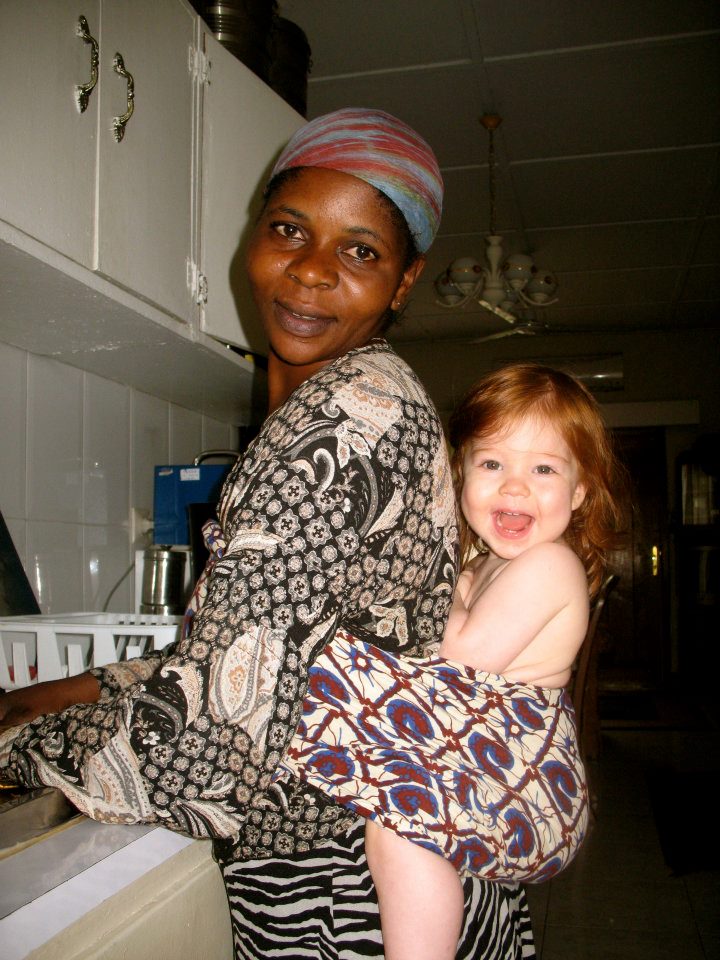
When Charlotte was born, they went to South Africa to have her because the resources in Congo are limited for mothers giving birth. My second niece, Annaïs, was born in the States last summer when they came home. Unfortunately, not all women in Congo have the opportunity to travel to have children. Around the same time Sarah had Charlotte, one of the Congolese helpers on campus had twins. Unfortunately, the mom died during childbirth. The two babies had no way of surviving without food from their mother. Sarah helped to provide milk to not only Charlotte, but two other babies as well.
Just a few months ago, Sarah, and Jill, the school nurse, helped deliver a baby of another Congolese woman. After that, Sarah mentioned the need for a non-profit organization in Congo to help make the birthing experience more pleasant for the mothers. With a serious lack of medication and 90 degree temperatures, the risk mothers face is extraordinary.

I don’t think that’s too bad of an idea.
Sarah and Adam just re-signed a contract to stay in Congo for another year. She now teaches ESL on campus and they both say it’s an amazing place to raise children.

Like I said earlier, I wanted to dedicate my last official post to her. I wanted to prove that you don’t actually have to be African to have an influence and to make a difference on that continent. She is truly a remarkable woman who has already left a mark on the continent and will continue to do so for a long time.
 ShoutOut! James Madison University
Good info.
I happened to help my daughter house sit while Sarah and Adam and Charlotte were out of the country. Don’t forget their adopted dog Falafal as part of the family.
LikeLike